Here at Isotope60, we have always been interested in radioactive decay. Radioactive decay is the process in which an unstable atomic nucleus of an atom loses energy by radiation, or the emission of a particle. One might think of this as being similar to throwing a big weight out of your car so your car rides smoother.
In the past, the only way to measure radiation was through the use of an expensive Geiger counter. This worked well, but was generally out of reach for the average amateur scientist. Fortunately, technology has advanced and one can now purchase a reasonably-priced radiation detector for home use. Recently, I purchased a RadiaCode 110 detector/spectrometer to help conduct some new experiments. I've carried this device around the world, and have measured radiation from 45 degrees north latitude to 54 degrees south latitude. It's also passed through the x-ray scanner at the airport on numerous occasions.
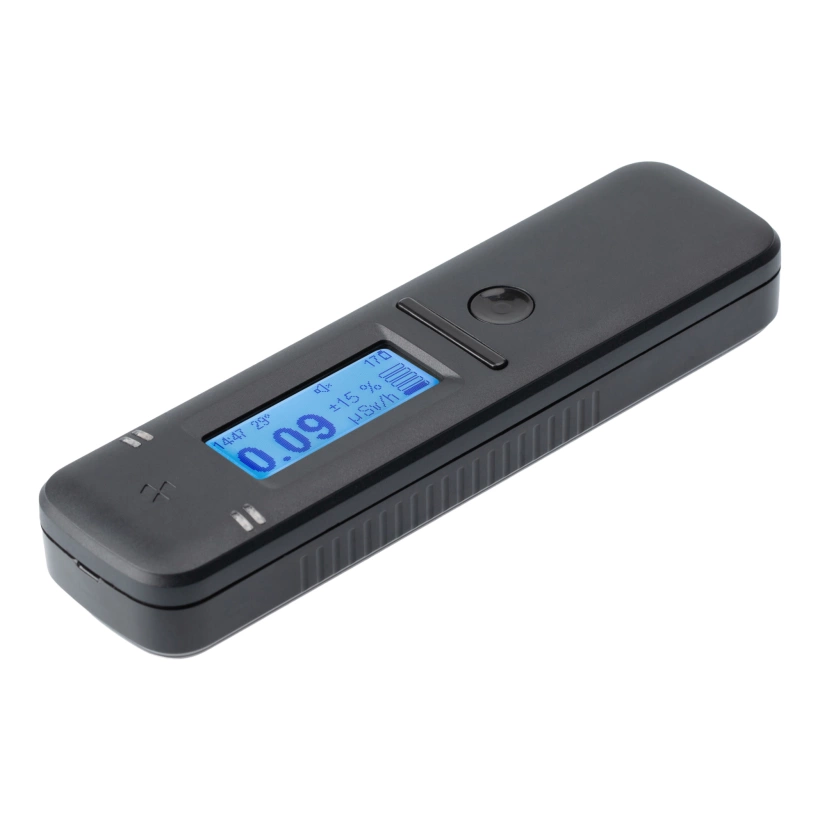 A Radiacode 110 Radiation Monitor
At one point, I managed to brick the detector after plugging it into a sketchy USB-C cable. Fortunately, RadiaCode was kind enough to work with me and their repair policy was incredibly helpful. I sent the broken device, plus the wall adapter and cable I used to Radiacode, where they were able to study what happened. Eventually it was repaired, and I'm back taking measurements. I have only very positive things to say about the team at RadiaCode for helping their customers, and they are highly recommended.
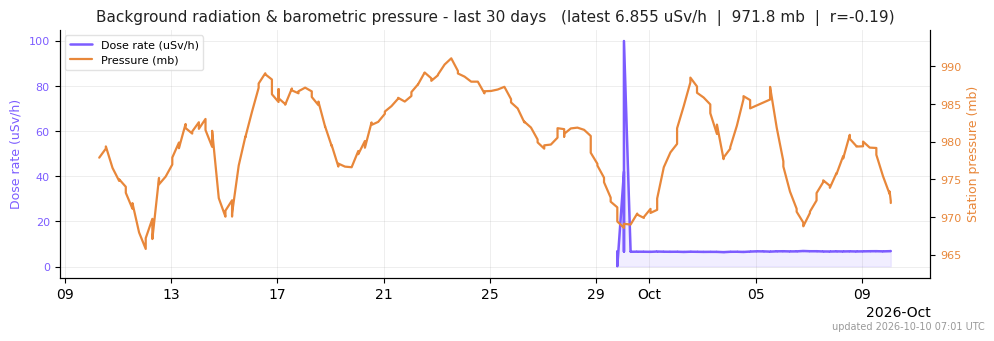
One of my recent ideas was to connect the Radiacode device to a computer, so I can monitor and log radiation in Minneapolis, Minnesota. The detector is sending data approximately once per second, and the plot above was created to study whether the change in barometric pressure (logged from a local Tempest weather station) correlates with any changes in atmospheric radiation. The plot cover the past 30 days, so this observation will take time to fully develop.